For a long time, advanced technology was a luxury only big brands could afford. Large companies had access to data scientists, automation systems, and enterprise software, while small businesses struggled with limited resources and manpower. Artificial Intelligence has completely changed that reality.
- Why AI Is a Game Changer for Small Businesses
- Breaking the Myth: AI Is Not Only for Tech Experts
- How Small Businesses Use AI in Daily Operations
- AI Levels the Marketing Playing Field
- Competing with Big Brands on Speed and Agility
- AI and Cost Efficiency for Small Teams
- Building Trust and Human Connection with AI Support
- Common Challenges Small Businesses Face with AI
- How to Start Using AI Without Overcomplicating Things
- The Future of Small Businesses in an AI-Driven World
- Frequently Asked Questions
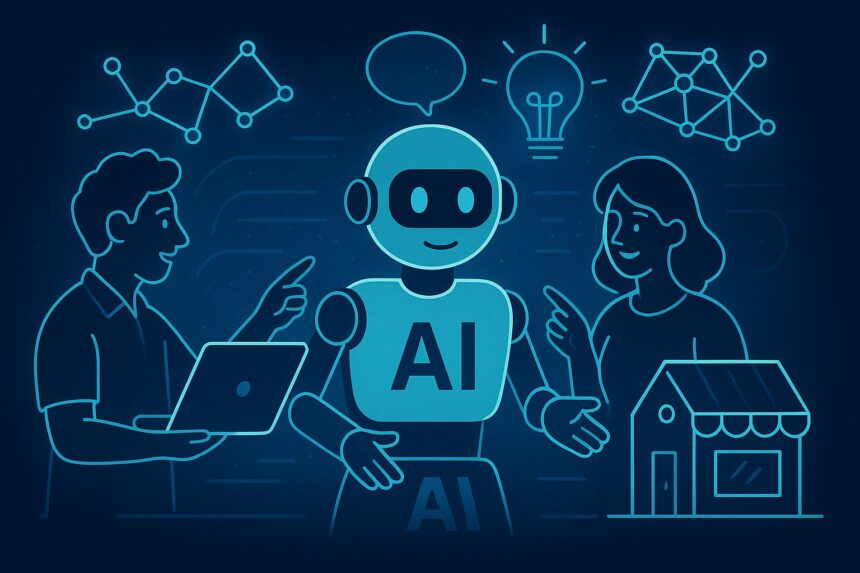
Today, AI allows small businesses and non-technical teams to compete with big brands on efficiency, speed, visibility, and customer experience. With the right approach, AI becomes a force multiplier that helps small teams do more with less—without requiring coding skills or large budgets.
Why AI Is a Game Changer for Small Businesses
Small businesses face constant pressure to grow faster, respond quicker, and market smarter, often with fewer people and tighter budgets. AI helps close this gap by automating repetitive work, analysing data instantly, and supporting better decision-making.
Instead of hiring multiple specialists, small teams can use AI tools to handle tasks like content creation, customer communication, forecasting, and optimisation. This allows business owners and employees to focus on strategy, creativity, and customer relationships rather than operational overload.
Breaking the Myth: AI Is Not Only for Tech Experts
One of the biggest misconceptions about AI is that it requires technical knowledge. In reality, modern AI tools are designed for everyday users. Most platforms operate with simple dashboards, natural language inputs, and ready-made workflows.
Non-tech teams can easily use AI to write content, respond to customers, analyse performance, and plan campaigns. The learning curve is minimal compared to traditional software systems, making AI adoption realistic even for first-time users.
How Small Businesses Use AI in Daily Operations
AI is already deeply integrated into many small business workflows, often without owners realising how powerful it is.
In marketing, AI helps generate content ideas, draft posts, optimise messaging, and analyse engagement. In customer service, AI-powered systems respond instantly to common queries, improving response times and customer satisfaction. In operations, AI assists with scheduling, forecasting demand, and tracking performance trends.
These capabilities allow small teams to function with the efficiency of much larger organisations.
AI Levels the Marketing Playing Field
Marketing is one area where AI delivers immediate impact for small businesses. Big brands invest heavily in research, testing, and optimisation. AI now brings those same capabilities to smaller teams.
AI analyses customer behaviour, identifies patterns, and predicts what type of messaging will work best. This results in more targeted campaigns, better conversion rates, and reduced wasted spend. Small businesses can now create personalised experiences at scale, something that was previously impossible without large teams.
Competing with Big Brands on Speed and Agility
While big brands have resources, they often lack agility. Small businesses, when powered by AI, can move faster and adapt quicker.
AI provides instant insights, allowing businesses to react to trends, customer feedback, and performance changes in real time. This speed enables small teams to experiment, optimise, and refine strategies without long approval processes or complex hierarchies.
In many cases, this agility gives small businesses a competitive advantage over slower-moving corporations.
AI and Cost Efficiency for Small Teams
Hiring specialists, outsourcing tasks, or expanding teams can be expensive. AI reduces these costs by automating high-effort, low-impact tasks.
Instead of spending hours on manual reporting, repetitive communication, or content formatting, AI handles these processes automatically. This not only saves money but also reduces burnout, improving team productivity and morale.
Over time, the cost savings generated by AI adoption often exceed the initial investment.
Building Trust and Human Connection with AI Support
AI does not replace human connection; it enhances it. By handling repetitive tasks, AI frees up time for business owners and teams to focus on building relationships with customers.
Personalised responses, consistent communication, and faster support all contribute to stronger trust. When AI is used thoughtfully, customers experience better service without feeling like they are interacting with machines.
Common Challenges Small Businesses Face with AI
Despite its advantages, AI adoption does come with challenges. Poor data quality can affect outcomes, and over-automation may reduce authenticity if not managed carefully. Some businesses also struggle with choosing the right tools or understanding how to measure success.
The key is to start small, focus on clear goals, and treat AI as a support system rather than a replacement for human judgment.
How to Start Using AI Without Overcomplicating Things
Successful AI adoption begins with identifying one or two areas where automation can make an immediate difference. This could be content creation, customer support, or analytics.
Once AI proves its value in a specific task, businesses can expand gradually. Continuous monitoring and human oversight ensure AI remains aligned with brand values and business objectives.
The Future of Small Businesses in an AI-Driven World
AI will continue to evolve, becoming more intuitive, affordable, and powerful. In the future, small businesses that embrace AI early will be better positioned to compete, scale, and innovate.
Rather than widening the gap between small and large companies, AI is narrowing it. With smart adoption, non-tech teams can achieve enterprise-level efficiency while maintaining the flexibility and authenticity that customers value.
Frequently Asked Questions
Can small businesses really compete with big brands using AI?
Yes. AI provides access to automation, analytics, and optimisation tools that were previously exclusive to large enterprises.
Do I need technical skills to use AI?
No. Most modern AI tools are built for non-technical users and require no coding or advanced setup.
Is AI expensive for small businesses?
Many AI tools are affordable and scalable, allowing businesses to start small and grow over time.
Will AI replace employees in small businesses?
AI supports employees by handling repetitive tasks, allowing humans to focus on creativity, strategy, and customer engagement.