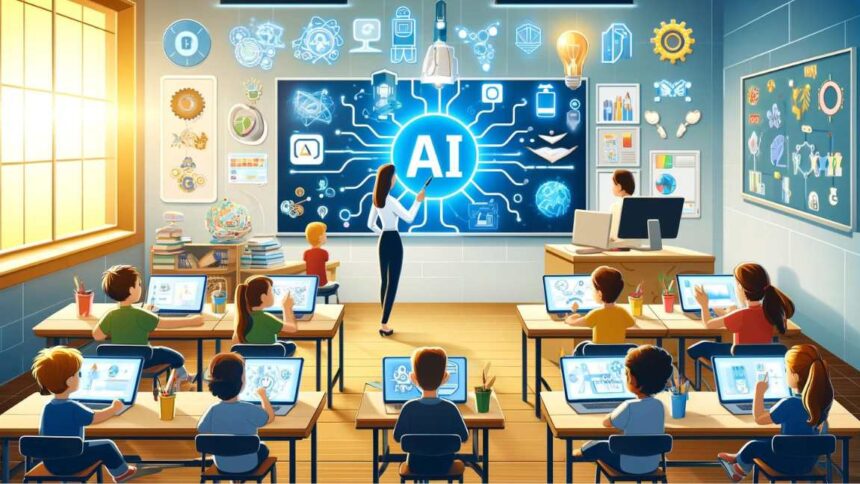
Education is no longer confined to classrooms, certificates, or fixed syllabi. In today’s skill-driven economy, learning has become continuous, personalised, and outcome-focused. Artificial Intelligence (AI) has transformed education from a rigid system into an adaptive learning experience—one where every learner can grow based on their pace, goals, and individual gaps.
- Why AI Is Creating Such a Strong Impact in Education
- Personalised Learning at Scale
- Skill Development and Career-Focused Education
- Intelligent Assessments and Real-Time Feedback
- Scalable Content Creation in Education
- Remote Learning and Global Access to Education
- AI-Driven Visibility for Local Educational Institutions
- Teachers and Trainers: From Content Deliverers to Mentors
- Ethics, Privacy, and Responsible Use of AI
- Challenges in Adopting AI in Education
- The Future of AI in Education
- Frequently Asked Questions
AI does not replace education or educators. Instead, it strengthens the ecosystem by empowering teachers, trainers, and learners to achieve better and more measurable results.
Why AI Is Creating Such a Strong Impact in Education
Traditional education followed a one-size-fits-all approach. Every student received the same content, moved at the same pace, and was evaluated using identical methods. In reality, learners differ significantly in abilities, interests, and learning speed.
AI analyses learner data to understand strengths, weaknesses, behaviour patterns, and preferences. Based on these insights, learning becomes responsive rather than reactive. Education shifts from being standardised to truly learner-centric.
Personalised Learning at Scale
AI-powered learning systems dynamically adjust content based on individual performance. When a learner struggles with a concept, the system offers additional explanations, alternative formats, or extra practice.
For fast learners, advanced modules and challenges are unlocked. For those who need more time, personalised support increases. This balanced approach reduces dropouts, builds confidence, and improves long-term retention.
Personalised learning is no longer a premium feature—it is quickly becoming the new standard.
Skill Development and Career-Focused Education
Modern education is increasingly aligned with employability. AI analyses skills demand, industry trends, and job market data to recommend relevant learning paths.
Learners receive clear direction on which skills to build, which courses to complete, what projects to work on, and which gaps need attention. Education becomes practical, measurable, and directly connected to career outcomes.
AI shifts education to an outcome-first model.
Intelligent Assessments and Real-Time Feedback
Assessment is no longer limited to final exams. AI enables continuous evaluation through quizzes, assignments, and learning interactions.
Learners receive instant feedback, allowing them to correct mistakes and improve immediately. This creates faster learning cycles and stronger understanding.
For educators, AI reduces manual grading and administrative workload, allowing more time for mentoring, guidance, and personalised support.
Scalable Content Creation in Education
Creating educational content—lesson plans, notes, assessments, and explanations—can be time-intensive. AI brings structure, speed, and scalability to this process.
Automated content creation tools help generate structured drafts such as lesson outlines, summaries, and practice materials. Educators can then focus on accuracy, creativity, and learner engagement.
With human review and refinement, AI-supported content becomes reliable, engaging, and learner-friendly.
Remote Learning and Global Access to Education
AI has made education truly borderless. Remote learning platforms use AI to track progress, personalise experiences, and maintain learner engagement.
Students can access high-quality education from anywhere in the world. Language translation, voice assistance, and adaptive interfaces reduce barriers and improve accessibility.
Education is becoming more inclusive, flexible, and globally connected.
AI-Driven Visibility for Local Educational Institutions
For schools, coaching centres, and training institutes, discoverability is critical. Students often search for trusted institutions nearby.
When institutions combine AI insights with professional local SEO services, visibility improves significantly. Accurate listings, reviews, and location-based optimisation help build trust and increase enquiries.
This ensures the right learners connect with the right institutions at the right time.
Teachers and Trainers: From Content Deliverers to Mentors
AI does not replace teachers—it evolves their role. Educators move away from repetitive content delivery and focus more on mentoring, guidance, and critical thinking.
Routine tasks such as grading, progress tracking, and reporting are handled by AI, freeing educators to spend more time on meaningful learner interaction.
Education remains human-centred, supported by smarter tools.
Ethics, Privacy, and Responsible Use of AI
Educational data is highly sensitive, especially when it involves children and young learners. With AI adoption, privacy, consent, and transparency become essential.
Responsible AI practices ensure data security, minimise bias, and provide fair learning opportunities. Trust remains the foundation of education, while technology serves as a supporting layer.
Challenges in Adopting AI in Education
Despite its potential, AI adoption faces challenges. Infrastructure limitations, digital literacy gaps, and lack of teacher training can slow implementation.
There is also a risk of over-automation. Human connection, motivation, and emotional intelligence remain critical to learning. The best outcomes emerge when AI and educators work together, not independently.
The Future of AI in Education
The future of education will be adaptive, modular, and lifelong. AI systems will grow alongside learners, continuously updating skills as industries evolve.
Degrees will matter, but skills, portfolios, and real-world competence will matter more. Education will shift from a one-time phase to an ongoing journey.
AI makes this journey more efficient, personalised, and meaningful.
Frequently Asked Questions
Will AI replace teachers?
No. AI supports teachers by reducing workload and enhancing learning outcomes. Human mentorship remains irreplaceable.
Is automated content creation safe for education?
Yes, when used for drafting and structure with proper human validation and quality checks.
Why are local SEO services important for educational institutions?
They help students discover nearby, trusted institutions and improve admissions and enquiries.
Is AI-based learning suitable for beginners?
Absolutely. AI adapts to the learner’s pace, making it ideal for beginners who need gradual and guided progress.