Manufacturing has always been driven by efficiency, accuracy, and scale. However, rising operational costs, global competition, and frequent supply chain disruptions have placed traditional manufacturing models under serious pressure. This is where Artificial Intelligence (AI) steps in—not just as an automation tool, but as a strategic transformation engine powering smart factories.
- What Is a Smart Factory?
- Predictive Maintenance: Eliminating Costly Downtime
- AI-Powered Quality Control and Visual Inspection
- Production Optimization and Operational Efficiency
- Smarter Supply Chains Through AI Intelligence
- Inventory Optimization and Cost Reduction
- AI as a Workforce Enabler, Not a Replacement
- Manufacturing Documentation and Process Automation
- Local Manufacturing Visibility and Market Trust
- Challenges in AI Manufacturing Adoption
- AI Benefits for Small and Mid-Sized Manufacturers
- The Future of AI in Manufacturing
- Frequently Asked Questions
AI does far more than automate repetitive tasks. It enables machines to analyze data, learn from patterns, and continuously optimize decisions. From the production floor to supplier networks, AI is reshaping how modern manufacturing operates.
This article explores how AI-driven smart factories are improving productivity, quality, and supply chain resilience across the manufacturing ecosystem.
What Is a Smart Factory?
A smart factory is an intelligent, connected manufacturing environment where AI, IoT, and data analytics work together. Machines, systems, and people operate as part of a unified digital ecosystem, constantly sharing and analyzing data.
In traditional factories, issues are addressed only after they occur. Smart factories work differently. They are predictive rather than reactive, identifying potential problems before they disrupt operations. This proactive approach leads to higher efficiency, lower costs, and better overall performance.
Predictive Maintenance: Eliminating Costly Downtime
Unplanned downtime is one of the most expensive challenges in manufacturing. AI-powered predictive maintenance addresses this problem by continuously monitoring machine health indicators such as vibration, temperature, and performance trends.
Instead of waiting for equipment to fail, AI predicts when a machine is likely to require maintenance. This allows manufacturers to schedule repairs in advance, reduce emergency breakdowns, and keep production running smoothly.
The result is fewer interruptions, lower maintenance costs, and significantly improved productivity.
AI-Powered Quality Control and Visual Inspection
Traditional quality inspections often rely on manual checks or rigid rule-based systems. AI vision technology takes quality control to an entirely new level.
High-resolution cameras and intelligent algorithms inspect products in real time, instantly identifying defects, dimensional variations, and inconsistencies. This not only minimizes human error but also ensures consistent product quality at scale.
More importantly, AI doesn’t just detect defects—it analyzes trends and provides insights that help improve production processes over time.
Production Optimization and Operational Efficiency
AI analyzes massive volumes of production data to uncover inefficiencies and bottlenecks. Factors such as machine utilization, cycle times, material flow, and energy consumption are continuously optimized.
By simulating multiple production scenarios, AI recommends the most efficient strategies to increase throughput while reducing waste. Decision-making shifts from intuition-based judgments to data-driven precision, resulting in faster production cycles and better resource utilization.
Smarter Supply Chains Through AI Intelligence
Supply chain disruptions have become a major risk for manufacturers worldwide. AI brings intelligence and predictability to supply chain management by analyzing demand patterns, supplier performance, logistics data, and external market signals.
AI can accurately forecast:
- Demand fluctuations
- Raw material shortages
- Transportation delays
With these insights, manufacturers can act proactively—securing alternate suppliers, adjusting inventory buffers, and optimizing delivery routes. AI transforms supply chains from fragile networks into resilient, adaptive systems.
Inventory Optimization and Cost Reduction
Both overstocking and stockouts can drain profits. AI solves this by analyzing real-time sales data, seasonal demand trends, and production schedules to maintain optimal inventory levels.
This intelligent approach reduces excess storage costs, minimizes tied-up capital, and ensures materials are available exactly when needed. Inventory management becomes a strategic advantage rather than a guessing game.
AI as a Workforce Enabler, Not a Replacement
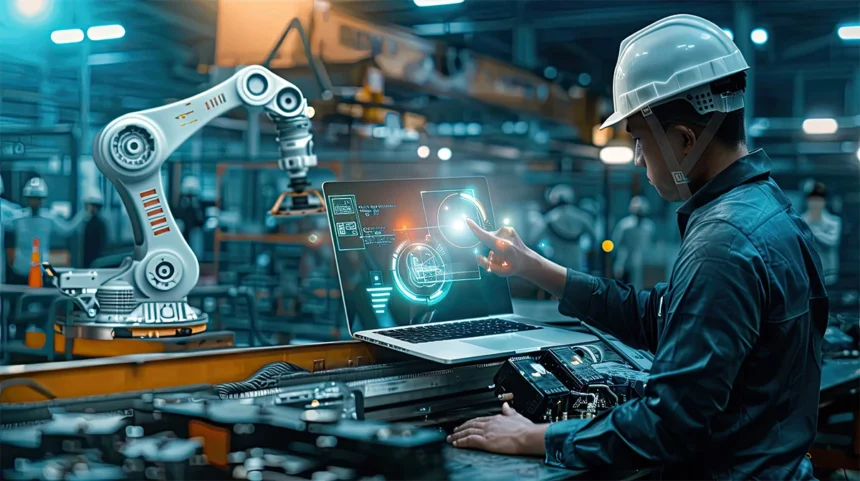
A common concern around AI is job displacement. In reality, AI in manufacturing is designed to augment human workers, not replace them.
AI systems handle repetitive, hazardous, and physically demanding tasks, allowing workers to focus on supervision, decision-making, and skill-based roles. This improves workplace safety, enhances job satisfaction, and creates opportunities for upskilling.
Human-AI collaboration is the true foundation of smart manufacturing.
Manufacturing Documentation and Process Automation
Documentation is critical in manufacturing—standard operating procedures, safety guidelines, training manuals, and compliance records must be accurate and up to date. Managing these manually is time-consuming and error-prone.
Automated content generation tools help manufacturing teams create structured drafts for technical documentation and internal guides. With proper human review, these tools improve consistency, reduce administrative workload, and maintain regulatory compliance.
Local Manufacturing Visibility and Market Trust
For manufacturers, especially at the local and regional level, trust and discoverability are essential. Buyers and partners prefer working with reliable, visible businesses.
When AI-driven insights are combined with professional local SEO strategies, manufacturers can improve their online presence, attract nearby buyers, and strengthen credibility. Better visibility directly influences leads, partnerships, and long-term growth.
Challenges in AI Manufacturing Adoption
While AI offers immense benefits, implementation can be complex. Legacy machinery, disconnected data systems, and integration challenges often slow adoption.
Cybersecurity is another concern, as connected systems increase exposure to digital threats. Successful AI adoption requires strong governance, secure infrastructure, and a phased rollout strategy.
Pilot projects and gradual scaling are the most effective paths to long-term success.
AI Benefits for Small and Mid-Sized Manufacturers
AI is no longer limited to large industrial plants. Small and mid-sized manufacturers can achieve substantial gains using scalable AI solutions.
Use cases like predictive maintenance, inventory optimization, and automated quality inspection deliver high returns even with modest investments. AI is making advanced manufacturing capabilities accessible to businesses of all sizes.
The Future of AI in Manufacturing
The factories of the future will be self-optimizing. AI systems will continuously learn, adjust production plans in real time, and create adaptive supply chains that respond instantly to change.
Manufacturing success will no longer depend on low-cost labor but on intelligent systems, speed, and resilience. Companies that adopt AI early will lead in quality, efficiency, and competitiveness.
Frequently Asked Questions
Will AI replace manufacturing jobs?
No. AI takes over repetitive and risky tasks, while human workers move into skilled, supervisory, and analytical roles.
Is automated content creation safe for manufacturing documentation?
Yes, when used for drafting and combined with human review to ensure accuracy and compliance.
Why is local SEO important for manufacturers?
Local SEO helps buyers and partners discover trusted manufacturers in their area, increasing visibility and credibility.
Is AI adoption expensive for manufacturers?
Not necessarily. With scalable tools and phased implementation, AI can be cost-effective and deliver strong ROI.